Concepts Overview
Welcome to the Project Inception
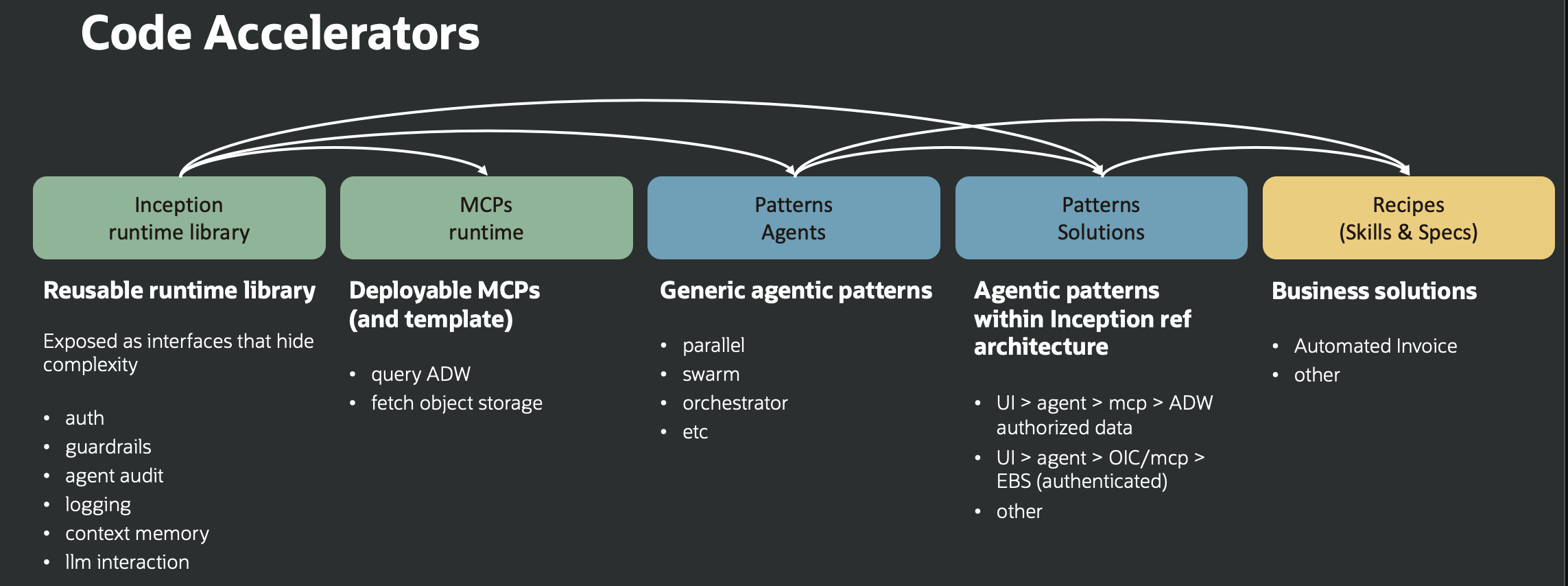
Inception brings enterprise applications into the era of agentic AI. Built on OCI Enterprise AI and the AI Data Platform, it provides a secure, governed, and standardized foundation for building and deploying intelligent agents across Oracle applications. With reusable patterns and proven recipes, teams can accelerate from idea to implementation 60–80% faster. The result is scalable, enterprise-grade AI that continuously improves—creating a flywheel where each deployment makes the next faster, unlocking innovation across the business.
Why this platform exists
Building production-grade AI agents is hard. Every project repeats the same foundational work: wiring up LLMs, setting up guardrails, managing memory, writing secure tool integrations, and provisioning infrastructure — weeks of effort before a single line of business logic ships.
Project Inception solves three recurring problems:
| Problem | How this platform addresses it |
|---|---|
| Foundational complexity | Pre-built libraries for LLM handling, guardrails, logging, and memory ship as reusable packages |
| Governance & compliance | OCI Guardrails, LangFuse audit trails, structured logging, and IAM token propagation are baked in by default |
| Speed to production | End-to-end recipes, Docker containers, Terraform templates, and application stubs eliminate scaffolding overhead |
Repository layout
inception_<customer_name>/
├── inception_core/          ← Shared libraries + accelerator patterns
│   ├── libs/                ← LLM factory, guardrails, logging, evals, DU tool
│   └── accelerators/        ← Runnable agent + solution patterns (incl. Swarm)
├── inception_mcp_servers/   ← FastMCP servers (SQLcl, Object Storage, ADW)
├── inception_skills/        ← recipe-builder + agentic-engineering skills —
│                               turn a use case into a full recipe, spec first
├── inception_recipes/       ← End-to-end domain implementations
│   ├── invoice_automation/  ← AP invoice processing with deep research agents
│   ├── smart_dispatch/      ← Multi-agent field service dispatch
│   ├── meridian_bank/       ← Loan approval swarm, dual-UI, deterministic decision
│   └── ebs_invoice_reconciliation/  ← AP three-way match, live-validated
├── applications_stub/       ← Production-ready starter app scaffolds
└── inception_devops/        ← Containers, Terraform, security automation
Core architectural concepts
Agent Definition
Every agent is composed of three runtime-configurable parts:
- System prompt — shapes reasoning, persona, and scope
- Model config — selects the LLM provider (OCI GenAI, OpenAI-compatible endpoints)
- Tools / skills — Python functions, MCP tool calls, and agent skills the agent can invoke
Agent Harness
The harness wraps the agent definition with production infrastructure:
- LangGraph — state-machine orchestration, conditional branching, multi-step reasoning loops
- OCI GenAI — native LLM inference (Cohere, Meta LLaMA, and other hosted models)
- LangFuse — full execution tracing: prompts, tool calls, token counts, latency, costs
- Oracle-backed checkpointing — persist and resume conversation threads by ID
- Memory store — virtual filesystem for long-term, episodic, semantic, and fleet-shared memory
MCP Tool Layer
Agents interact with external systems exclusively through Model Context Protocol servers. Each MCP server has a predictable 3-file structure:
server.py    ← bootstrap: loads env, creates FastMCP, starts transport
registry.py  ← exposes only explicitly registered tools at startup
tools.py     ← implements all tool functions
This makes tool surface area explicit, auditable, and easily extended.
Governance by Default
Security and observability are not afterthoughts:
- OCI Guardrails — content safety and topic policy enforcement on all agent I/O
- LangFuse — every chain step traced; replay any session for root-cause analysis
- IAM token propagation — end-user IDCS identity flows through the stack to the database layer
- VPD row-level security — Oracle Virtual Private Database enforces role-based data access per session
Platform architecture
┌─────────────────────────────────────────────────────────────────┐
│                      UI / API Layer                              │
│   React dashboards · FastAPI services · Node gateways · CLI     │
└────────────────────────────┬────────────────────────────────────┘
                             │
                             ▼
┌─────────────────────────────────────────────────────────────────┐
│                 Governance Layer                                 │
│   AI Guardrails · Security Policies · Auditing & Logging        │
└────────────────────────────┬────────────────────────────────────┘
                             │
                             ▼
┌─────────────────────────────────────────────────────────────────┐
│              Agent Orchestration Layer                           │
│   LangGraph · Deep Agents · HITL · Routing · Memory Patterns    │
└─────────────┬───────────────────────────────┬───────────────────┘
              ▼                               ▼
┌─────────────────────────┐     ┌─────────────────────────────────┐
│   LLM Provider Layer    │     │       MCP Tool Layer            │
│   OCI GenAI / OpenAI    │     │   SQLcl · Object Storage · ADW  │
└─────────────────────────┘     └─────────────────────────────────┘
              ▼                               ▼
┌─────────────────────────────────────────────────────────────────┐
│              Data · Memory · Policy Layer                        │
│   Oracle ADB · OracleDBSaver · OracleStore · IAM/OIDC · VPD    │
└─────────────────────────────────────────────────────────────────┘
The 7 AI Agent Design Patterns (+ Swarm)
The platform implements all seven canonical agentic patterns as runnable, composable templates, plus a peer-to-peer Swarm topology for multi-intent conversations that don't fit a fixed sequence:
| # | Pattern | Description |
|---|---|---|
| 1 | Augmented LLM | Foundation — LLM enhanced with retrieval, tools, and memory |
| 2 | Prompt Chaining | Sequential LLM stages with quality gates between steps |
| 3 | Routing | Classify input, dispatch to specialized handlers |
| 4 | Parallelization | Split subtasks across parallel LLM workers and merge results |
| 5 | Orchestrator-Workers | Central LLM plans and delegates to specialized worker agents |
| 6 | Evaluator-Optimizer | Generate → Evaluate → Retry loop until quality criteria are met |
| 7 | Autonomous Agent | LLM-directed tool-use loop with guardrails — the most powerful and hardest to control |
| + | Swarm | Peer agents hand off control to each other directly — no central router. See Meridian Bank for the production example |
Who this documentation is for
| Audience | Start here |
|---|---|
| Developers with a new use case | Inception Skills — one prompt, spec first, then a full recipe |
| AI engineers building agentic workflows | Accelerators → Recipes |
| Platform engineers operating OCI | MCP Servers → DevOps |
| Solution architects | Architecture → Solution Patterns → Capability Matrix |
| New team members | Getting Started → this page |
Recommended reading path
- Platform Architecture — understand how layers relate
- Capability Matrix — scan all capabilities at a glance
- AI Core Libraries — reusable foundation primitives
- Agentic Accelerators — patterns and templates, including Swarm
- Solution Patterns — identity propagation and integration reference implementations
- MCP Servers — tool execution layer
- Recipes — end-to-end domain examples
- Inception Skills — turn your own use case into the next recipe
- Getting Started — run the platform locally